
Solar Module Assembly
The solar module assembly process combines photovoltaic (PV) cells with other components into a durable, weatherproof, and ready-to-install panel. The procedure involves multiple steps, from connecting individual cells into strings to framing and testing the final product.

Components of a solar module
The following materials are assembled to create a finished solar module:
Solar cells: Thin silicon wafers that convert sunlight into electricity.
Encapsulant: A polymer sheet, typically ethylene-vinyl acetate (EVA), that seals and cushions the solar cells.
Backsheet: A protective polymer or glass sheet on the back of the module that provides electrical insulation and moisture protection.
Glass cover: A sheet of tempered glass that protects the cells from environmental damage.
Frame: An aluminum frame that provides structural rigidity and protects the edges of the laminate.
Junction box: An electrical housing attached to the back of the panel that contains bypass diodes and provides a connection point for wiring.
Step-by-step assembly process
Preparation of materials: Raw materials, including the glass, backsheet, and encapsulant, are cut to the appropriate size and cleaned to ensure optimal quality.
Cell stringing: Individual solar cells are soldered together in series using copper ribbons. An automated “stringer machine” handles this process with precision to create long rows of connected cells.
Layup: The interconnected strings of cells are carefully arranged in a matrix pattern onto a sheet of glass, which is already covered with a layer of encapsulant.
Bussing soldering: The different strings of cells are then interconnected using a thicker bus ribbon to complete the electrical circuit.
Pre-lamination: A second sheet of encapsulant and the backsheet are placed on top of the cell matrix, creating a “sandwich” of materials.
Lamination: The entire assembly is placed in a laminator. Heat and pressure are applied in a vacuum to melt the encapsulant, permanently bonding all the layers together and creating a waterproof seal.
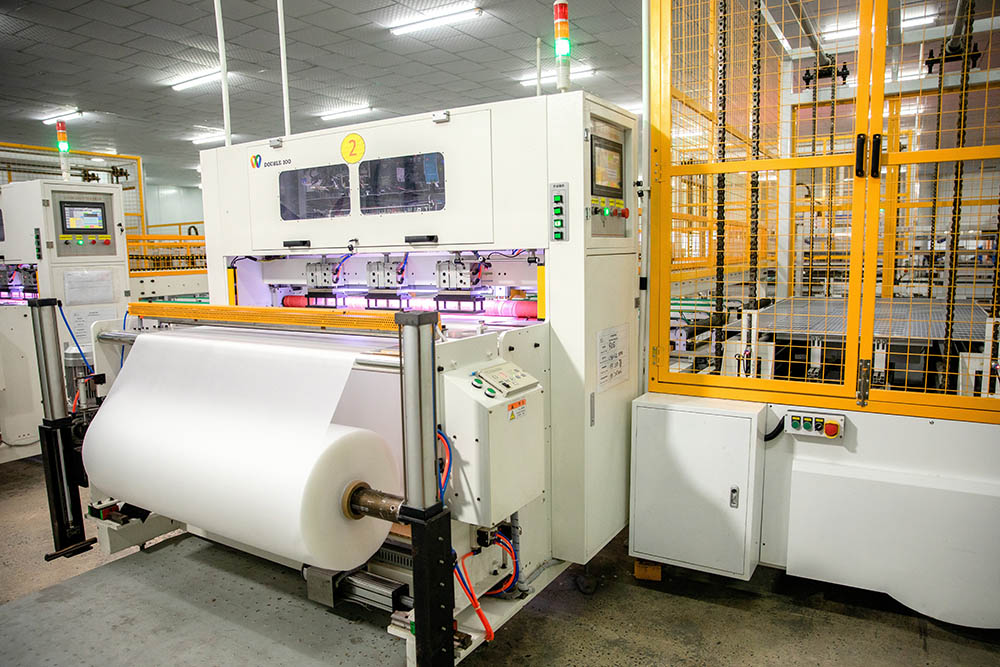
Trimming: Excess encapsulant and backsheet material are trimmed away from the edges of the laminated module.
Framing: A sealant is applied along the edges of the laminate, and an aluminum frame is fitted and secured to provide structural strength.
Junction box attachment: The junction box is attached to the back of the module. The ribbons from the cell matrix are connected to the junction box, which contains bypass diodes to protect the panel from damage due to shading.
Testing and quality control: The finished module undergoes a series of rigorous tests, including:
Visual inspection: A thorough check for any defects like cracks or foreign particles.
Electrical testing: A flash test under simulated sunlight to measure the module’s power output, voltage, and current.
Electroluminescence (EL) testing: An internal scan to detect micro-cracks or other hidden cell defects.
Hi-Pot test: A high-voltage test to verify the electrical insulation and safety of the module.
Packaging: Modules that pass all quality checks are packaged and prepared for shipping.